Piano Tips
Old Piano in the Way? How to Decide Between Selling and Disposal
May
Last updated: May 11, 2026
Trying to figure out what to do with an old piano is one of those problems that looks simple until you start moving it. The answer is almost always: find out what it is worth before you agree to anything. A genuine Heintzman, Mason & Risch, or Nordheimer can be worth selling or donating. A no-name spinet from the 1970s with a cracked soundboard is usually a piano disposal job, not a resale opportunity.
This guide walks through the 5 quick checks every GTA homeowner should run before they call a mover, a dealer, or a junk removal service. It will save you from paying to move a piano nobody will buy, and from scrapping an instrument that still has a second life in it.
In this article
- Start with the maker, not the piano
- Check the soundboard and the bridges
- What to do with an old piano that is actually sellable
- Access matters more than most people think
- When disposal is the right answer
- What piano removal actually costs in the GTA
- Before you decide, do this one thing
- Frequently asked questions
Start with the maker, not the piano
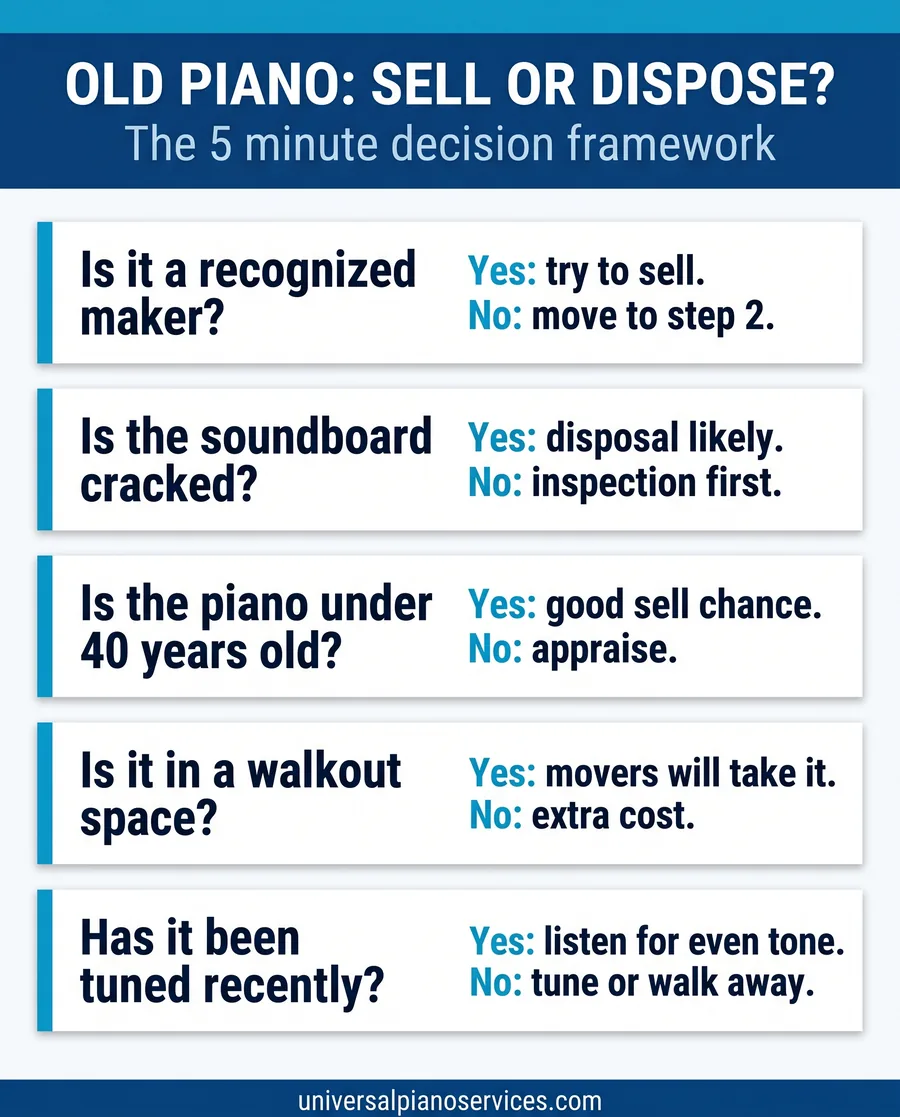
The first thing to look at is not the finish or the keys. It is the fallboard above the keys, and inside the top lid. Every acoustic piano has a maker name, a serial number, and usually a city of manufacture. Type the maker name into Google plus “piano history” and see what comes back. Old Canadian names that still carry value include Heintzman, Gerhard Heintzman, Mason & Risch, Nordheimer, Lesage, Willis, and Nocturno. American and European names that still move in the Toronto market include Steinway, Baldwin, Mason & Hamlin, Yamaha, Kawai, and Young Chang.
If the nameplate reads something like “Stencil Piano Co.” or a department store brand (Sears, Eaton’s), you are almost certainly looking at a stencil piano: a budget instrument built by a third party and rebranded. Those rarely resell. Skip the listing sites and move to the disposal question.
Check the soundboard and the bridges
Open the lid. The large flat wooden panel behind the strings is the soundboard. Run your eyes across it. A hairline crack that runs with the grain is usually fine and quite common in pianos over 40 years old. A crack that crosses the grain, or one wide enough to slip a business card into, is a structural problem. That piano is not going to sell.
Next look at the bridges: the long curved wooden strips the strings pass over. Split bridges and loose bridge pins are expensive to fix and almost never worth fixing on a low-end piano. If you see either, move on to the disposal branch. For a more thorough check, a piano appraisal from a Registered Piano Technician costs far less than a wasted move, and it is the only way to get a real number on what the instrument is worth.
What to do with an old piano that is actually sellable
If the piano passes the maker check and the soundboard check, you have something worth listing. Two paths work in the GTA. Private sale through Kijiji or Facebook Marketplace gives you the highest price but the longest wait, and you will do all the scheduling and the haggling. Trading in to a dealer who buys used pianos gives you less money but a clean same-week exit.
Universal Piano runs a direct we buy your piano service for GTA residents where we inspect, quote, and pay on the spot for acoustic pianos worth taking in. That is the fastest route if the instrument is worth selling but you are not in a mood to host 15 strangers in your living room.
Either way, get it tuned first, or at least have someone sit and play every key. Pianos that hold pitch fetch real money. Pianos that rattle do not.
Access matters more than most people think
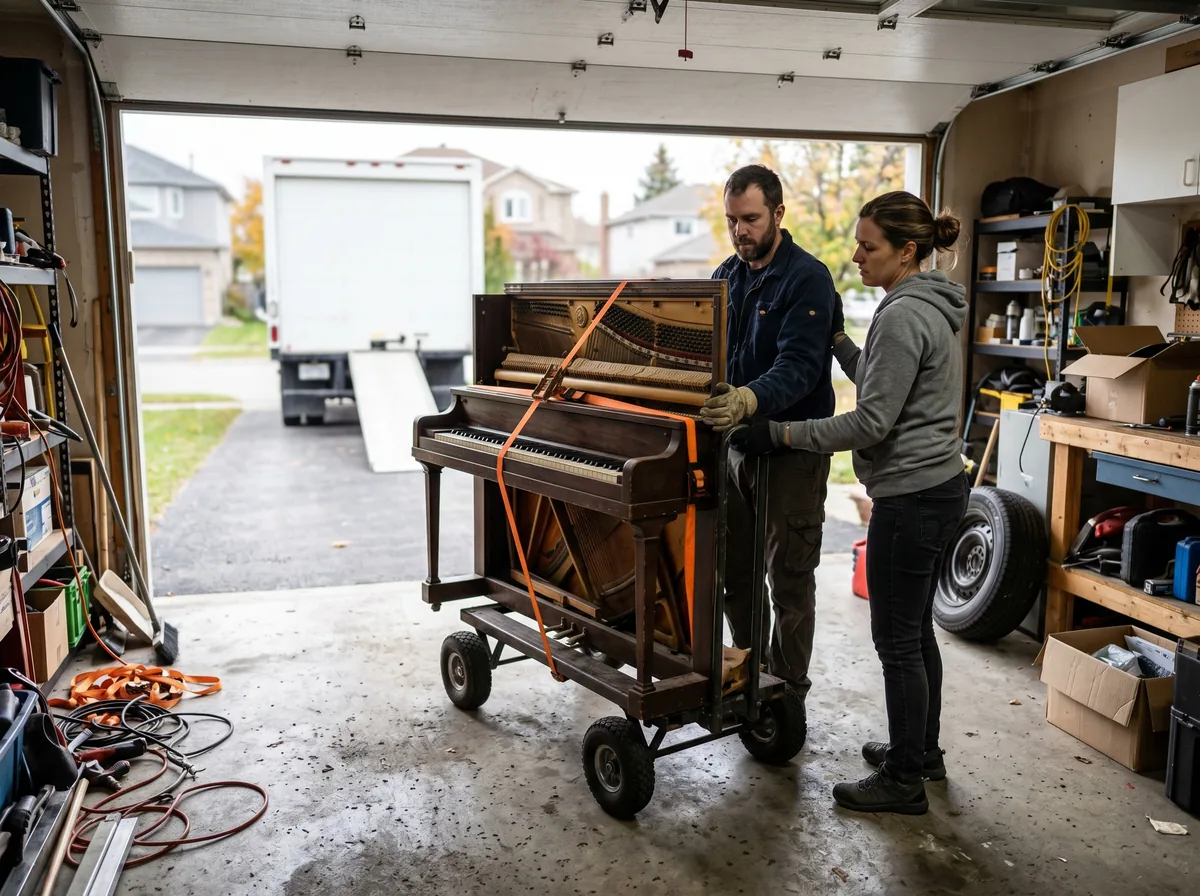
A buyer or mover is not just paying for the instrument. They are paying to get it out of your home. An upright on the main floor with a level path to the driveway is easy. An upright in a below-grade basement with a narrow staircase and a hard left turn is a four-person job and triples the cost. If the piano lives down a staircase, budget more in either direction: a buyer will pay less, and a piano moving service will quote more.
Baby grands are easier to move in one respect: the legs and pedal lyre come off, so the body travels on a side-lay board. They are harder in another: they are longer, heavier, and cannot make tight turns without a full disassembly.
When disposal is the right answer
If the piano fails the maker and soundboard checks, or if you have tried the resale route for 30 days with no takers, disposal is the honest answer. In the GTA, three paths work.
- Professional piano removal. A crew that moves pianos every day can get one out of a finished basement in under an hour and take it to a scrap yard. Expect $250 to $600 depending on access. This is what most GTA homeowners end up doing.
- Municipal bulky waste. The City of Toronto residential waste collection program will take a piano only if it is at the curb. Getting it there is your problem. Other GTA cities have similar rules. Check your municipal bylaw before you count on this path.
- Donation to a community group. Schools, churches, and community centres sometimes accept a playable piano for free. Almost none of them will pay to move it. You pay the move, they accept the piano.
Do not let anyone pressure you to leave a piano on the street overnight. It is a fire risk, a hazard, and in most GTA municipalities it is a bylaw fine.
What piano removal actually costs in the GTA
Budget ranges we see in 2026 for GTA jobs, for a standard upright piano with ground-floor or one-flight access:
- Ground floor, walkout to driveway: $250 to $400
- One flight of stairs up or down: $350 to $550
- Below-grade basement, narrow staircase, tight turn: $500 to $900
- Baby grand, main floor walkout: $400 to $700
- Baby grand, basement or second floor: $700 to $1,400
Ranges are honest because every GTA home is different. Row houses in the Junction or Roncesvalles can have tighter corners than a Mississauga detached. Emergency or same-day jobs add 20 to 40 percent. Universal Piano covers piano removal across the GTA and will quote a flat number over the phone if you can describe the access.
Before you decide, do this one thing
Take five photos: the nameplate, the inside of the lid, the soundboard, the keyboard, and the room the piano lives in. Send them to a piano appraiser or dealer and ask two questions: “Is this worth selling?” and “What will it cost me to move?”. Most reputable dealers in Toronto will answer both for free based on photos. That is a 10-minute errand that decides everything else.
A proper appraisal is still the safer move if the name on the fallboard suggests any real value, especially for older Heintzman pianos and other vintage Canadian makes. The Piano Technicians Guild explains what a Registered Piano Technician actually does and why the RPT credential matters when you are buying, selling, or disposing of an acoustic piano.
Old piano: sell or dispose? 8-step checklist – free PDF download
The 8-point checklist in a 1-page printable so you can work through it in front of the piano.
Download the free guideFrequently asked questions
What is the single biggest reason an old piano will not sell?
A cracked or failing soundboard. Everything else (cosmetic wear, a missing key, sticky action) can be fixed for a few hundred dollars. A soundboard replacement on an upright runs thousands and is almost never economical.
How much does it cost to dispose of a piano in the GTA?
For a standard upright with reasonable access, budget $250 to $600 for professional removal in 2026. Baby grands run $400 to $1,400 depending on access and whether a side-lay disassembly is needed. Below-grade basements with tight turns push the top of the range.
Can I just put a piano out for bulky waste pickup?
In the City of Toronto and most GTA municipalities, bulky waste crews will only take a piano if it is already at the curb. Getting a 600 lb upright from a living room to the curb is the hard part, and doing it yourself risks the piano going through a wall or down a flight of stairs. For most homeowners, paying a crew is safer and often cheaper.
Are old Heintzman and Mason & Risch pianos actually worth money?
Sometimes, yes. A well-kept Heintzman grand can still fetch four figures on the GTA market, and fully restored examples sell for more. A Heintzman upright with a cracked soundboard is worth scrap. The only way to know which you have is to get the instrument looked at by a Registered Piano Technician, ideally before you list it.
Will a charity take my old piano for free?
A few will, but they almost never cover the move. Schools, churches, and community centres sometimes accept a playable piano as a donation, but they expect you to pay the professional mover. If the piano fails the maker and soundboard checks, charities are unlikely to take it at all.
Keep reading
Universal Piano has served Toronto and the GTA since 1982. We buy acoustic pianos worth reselling, we move pianos safely across Mississauga, Markham, and every GTA city, and we handle safe disposal when an instrument has reached the end of its life. Call or text for a photo-based quote, or use the contact form to describe your piano and your access. We will tell you honestly whether to list it or let it go.