Piano Tips
Piano restoration costs in the GTA: what to expect in 2026
Jun
Last updated: June 24, 2026
Grandma’s upright piano has been sitting in the basement for over 30 years. It hasn’t been tuned since the early 90s, the finish is faded, and three keys stick. You know it probably needs work, but you have no idea how much work or whether it is worth doing at all.
Piano restoration costs in the GTA range from a few hundred dollars for basic regulation to $8,000 or more for a full rebuild. Where your piano falls on that spectrum depends on its age, brand, condition, and what you actually need done. Universal Piano Services handles piano restoration and repair across the GTA, and this guide breaks down exactly what you should expect to pay.

Is piano restoration worth it?
Before talking dollars, you need to answer one critical question: Is the piano actually worth restoring?
A rough rule of thumb states that if the cost of restoration exceeds twice the piano’s current market value, it usually doesn’t make financial sense. However, market value isn’t the whole story. A sentimental instrument passed down through a family, or a high-quality vintage Steinway that would be worth $15,000 fully restored, can absolutely justify a $6,000 restoration cost.
The structural components matter most when making this decision. A cracked cast iron plate (the harp inside the piano) is typically a dealbreaker because replacing it is prohibitively expensive and rarely successful. A cracked soundboard is more nuanced. Hairline cracks from dryness don’t necessarily affect tone, but deep splits running through the bridge definitely do. A deteriorated pinblock can be replaced, but it remains one of the more expensive repairs.
Cosmetic issues like faded finish, yellowed keys, and worn felt are almost always worth fixing on a structurally sound piano. These targeted repairs dramatically change how the instrument looks and plays without requiring a full rebuild.
How much does piano restoration cost by type?
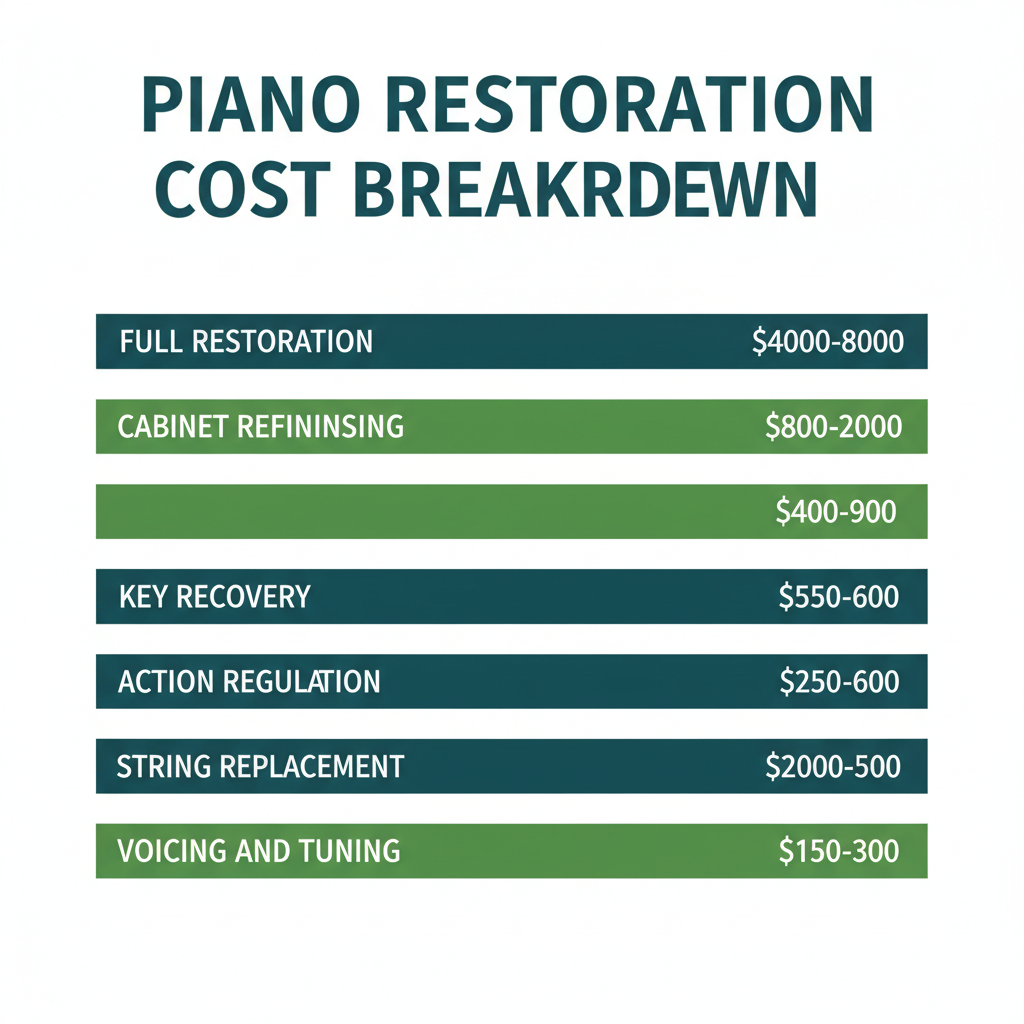
Based on Universal Piano Services’ decades of experience repairing instruments across Toronto, here is what individual restoration services typically cost in the GTA in 2026. Please note that these are ranges and not flat rates. Your piano’s specific condition, size, and brand will move the final number in either direction.
| Restoration type | Typical cost (CAD) | Notes |
|---|---|---|
| Full restoration | $4,000 to $8,000+ | Soundboard, strings, keys, cabinet, action |
| Cabinet refinishing | $800 to $2,000 | Stripping, sanding, and new finish coat |
| Key recovery (white keys) | $400 to $900 | Acrylic keytops replace old ivory or plastic |
| Action regulation | $250 to $600 | All 88 keys adjusted for consistent touch |
| String replacement | $2,000 to $5,000 | Depends on piano size and number of strings |
| Pinblock replacement | $1,500 to $4,000 | Necessary when piano cannot hold a tuning |
| Voicing | $200 to $450 | Adjusting tone by modifying hammer hardness |
| Tuning after restoration | $150 to $300 | Multiple sessions needed for pitch raise |
What factors increase piano restoration prices?
Several variables can push your piano restoration costs toward the higher end of any given range. Here are the main culprits:
- Piano size: A full-size upright or concert grand has more strings, more action parts, and more surface area to refinish than a studio upright or baby grand. Larger pianos naturally cost more to restore in almost every category.
- Age and original build quality: Older pianos often have parts that are no longer manufactured. Your technician will have to source parts from specialty suppliers or fabricate them from scratch. European-built pianos from the early 1900s sometimes use measurement standards that are not compatible with modern replacement parts.
- Years of neglect: A piano that has gone 20 years without tuning will need a pitch raise before a standard tuning session can even begin. Multiple tuning sessions mean more cost. Action parts that have not been regulated for decades are often harder to adjust and may need full replacement.
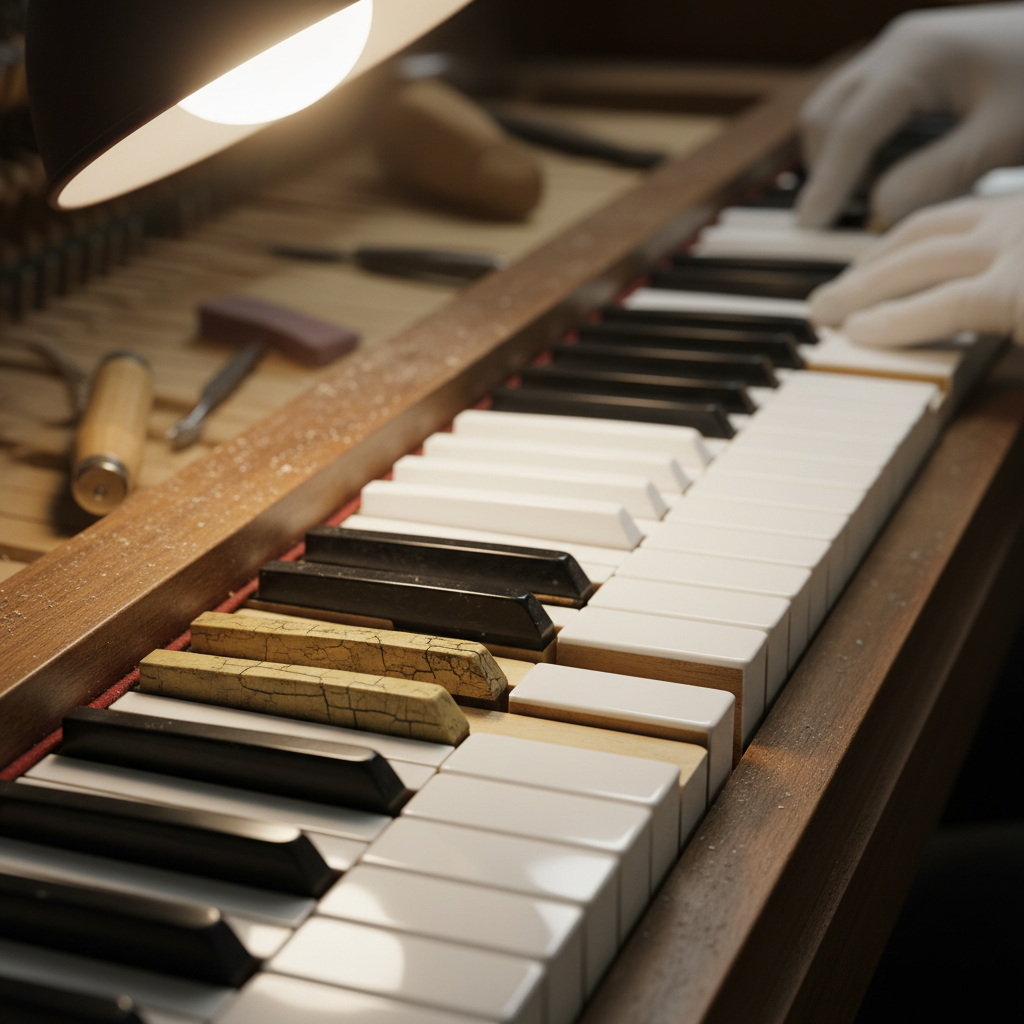
- Cosmetic damage: Refinishing a piano with deep scratches, severe water damage, or bubbled veneer takes significantly longer than refinishing one with normal wear. Professional veneer repair is a highly skilled and time-intensive process.
Should I restore my old piano or buy a new one?
This is the exact question most people are really asking when they look at restoration costs. The answer comes down to the quality of your original instrument.
For a high-quality instrument, restoration almost always wins. A fully restored Yamaha U1 or Kawai K-300 will play and feel better than a brand new entry-level piano costing the exact same amount. Quality piano mechanisms built decades ago often outperform their modern equivalents at the same price point due to superior materials.
For a low-quality instrument, replacement often wins. If the piano is a generic department store brand from the 1970s and restoration would cost $4,000, that money buys a substantially better instrument if you apply it to a good used piano instead. See our page on choosing the right piano if you are considering a replacement.
What is the process for a full piano restoration?
A full piano restoration is not a one-day job. It requires precision, patience, and a highly controlled environment. Here is a realistic timeline of what the process actually looks like:
- Professional Assessment: A qualified technician examines the piano and gives you a written estimate. This usually takes 30 to 60 minutes and may cost $50 to $100 for the technician’s time. For a free assessment, contact Universal Piano Services for a piano appraisal in the GTA.
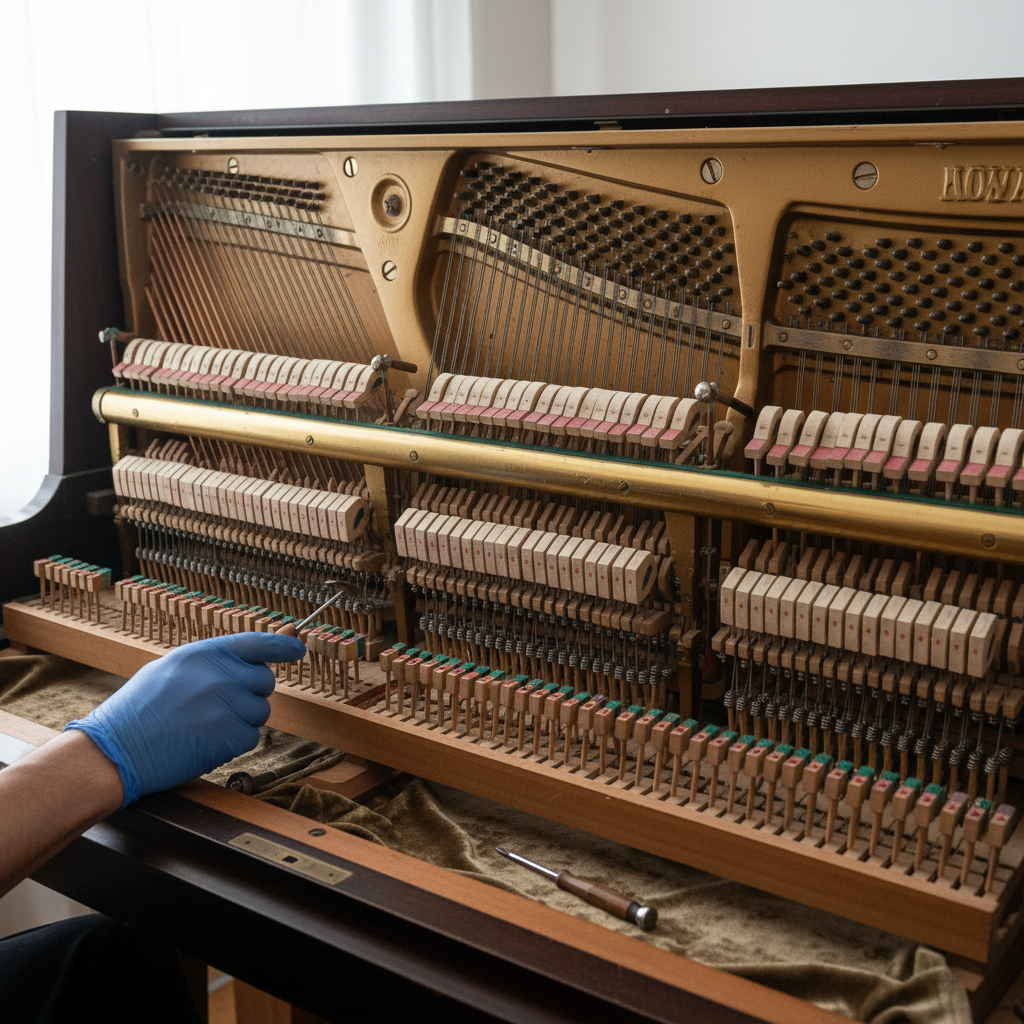
- Disassembly: The piano’s interior components are carefully removed, inspected individually, and either cleaned, repaired, or replaced. This is where most of the skilled labour happens.
- Structural work: Pinblock replacement, soundboard crack repair, and bridge work happen at this stage. These repairs are invisible when the piano is fully assembled but serve as the critical foundation everything else depends on.
- Action work: Worn felt bushings, broken flanges, and deteriorated dampers are systematically replaced. The action is then meticulously regulated so every key has a consistent touch weight and response.
- Refinishing: The cabinet exterior is stripped, sanded, filled, and refinished. High-quality restorations use a polyester or lacquer finish polished to a high-gloss or satin appearance.
- Voicing and tuning: Once reassembled, the hammers are voiced to bring out the piano’s unique tonal character. Multiple tuning sessions follow over the first few months as the new strings stretch and settle.
A partial restoration typically takes 2 to 4 weeks. A full restoration can easily run 3 to 6 months. Your piano will need to remain at the professional workshop for most of that time.
How do GTA winters affect your piano?
GTA winters create a specific problem for pianos that makes restoration work slightly more complex here than in milder climates. Forced-air heating in Ontario homes drives indoor humidity well below 30% for months at a time. Wood contracts, glue joints loosen, and soundboard crack propagation accelerates rapidly in these dry conditions.
If your piano has suffered from decades of GTA winters without a humidity control system, a full assessment must include checking for soundboard issues beyond what is visible. The technician should tap the soundboard and listen for the characteristic dull thud that indicates a loose or cracked rib on the underside.
Post-restoration, a strict piano care routine will protect your investment. We highly recommend installing a Dampp-Chaser humidity control system inside the piano. These systems run $300 to $600 installed and significantly extend the life of any restoration work done in a harsh GTA climate.
Download the piano restoration cost guide
Get the full cost breakdown as a printable PDF, including a checklist for deciding whether restoration is worth it for your specific instrument.
What are the most frequently asked questions about piano restoration?
How much does it cost to restore an old upright piano in the GTA?
A basic service including tuning, regulation, and minor repairs runs $250 to $600. A full restoration including strings, cabinet refinishing, and an action rebuild can run $4,000 to $8,000 or more depending on the brand and condition.
Is it worth restoring a 50-year-old piano?
It depends heavily on the brand and structural condition. A well-made Yamaha or Kawai from the 1970s can be an excellent candidate for restoration. A generic piano from that era rarely justifies the cost. Have a qualified piano technician assess the soundboard, pinblock, and plate before committing to a budget.
How long does piano restoration take?
Partial work like refinishing, key recovery, or regulation takes 2 to 4 weeks. A full restoration with strings, soundboard work, and refinishing typically runs 3 to 6 months. The piano will need to remain at the workshop for most of that time.
What is the most expensive part of piano restoration?
String replacement and pinblock replacement are the most costly single repairs. Each can run $1,500 to $5,000 depending on the piano’s size. A full set of custom bass strings alone can easily cost $500 to $1,200 for a grand piano.
Can a piano with a cracked soundboard be restored?
Sometimes. Hairline cracks from seasonal dryness may not affect tone and can easily be filled. Cracks that run through the bridge or that have caused the soundboard to lose its crown are much more serious. A qualified technician can assess whether the damage affects playability or is purely cosmetic.
The best first step for any piano restoration project is an honest assessment from a technician who has physically seen the instrument. Estimates based purely on a description or photos are almost always inaccurate. If you live in the GTA and want to know what your piano is truly worth restoring, contact Universal Piano Services for a professional assessment.