Piano Tips
What Makes a Heintzman Piano so Special? A Buyer’s Guide
Jul
Last updated: June 29, 2026
If you are trying to work out the heintzman piano value of a specific instrument, the short answer is: it depends entirely on which era built it, how it has been maintained, and whether the action has been rebuilt. A fully restored 1920s Heintzman grand is a genuinely valuable Canadian instrument. A 1990s Heintzman-branded upright built offshore is a serviceable student piano, nothing more. This guide is the plain-English version of that distinction, written for GTA buyers using our piano buying guide framework.
We will cover the five eras of Heintzman, what to inspect in each one, what they realistically sell for in Toronto in 2026, and when to politely walk away. If you end up wanting a hands-on assessment, the piano appraisal team at Universal Piano inspects Heintzmans weekly and can tell you within about ten minutes which era yours is and what it should cost.
In this article
- Why the Heintzman name still matters
- The five eras of Heintzman, and what each one is worth
- How to read the serial number and date the piano
- What to inspect on a used Heintzman before buying
- Realistic GTA prices for a used Heintzman in 2026
- When to walk away from a Heintzman
- Get a professional assessment before you write a cheque
- Frequently asked questions
Why the Heintzman name still matters
Heintzman & Co was founded in Toronto in 1860 by Theodore Heintzman, a German-trained piano builder. For about seventy years, roughly 1870 to 1930, Heintzman was the premier piano of Canada: the instrument that concert halls, wealthy homes, and Canadian musicians bought when they wanted a serious instrument. Production peaked in a large factory in the Junction neighbourhood of Toronto, which is why GTA homes still turn up Heintzmans today more than any other Canadian make.
The brand was sold several times from the 1980s onward, and modern Heintzman-branded pianos are built in China to a completely different spec. They are not continuous with the Toronto-built instruments. Knowing which one you are looking at is the whole game.
The five eras of Heintzman, and what each one is worth
Five distinct eras produced what people call a “Heintzman”. Each has its own quality, its own inspection focus, and its own realistic GTA resale value.
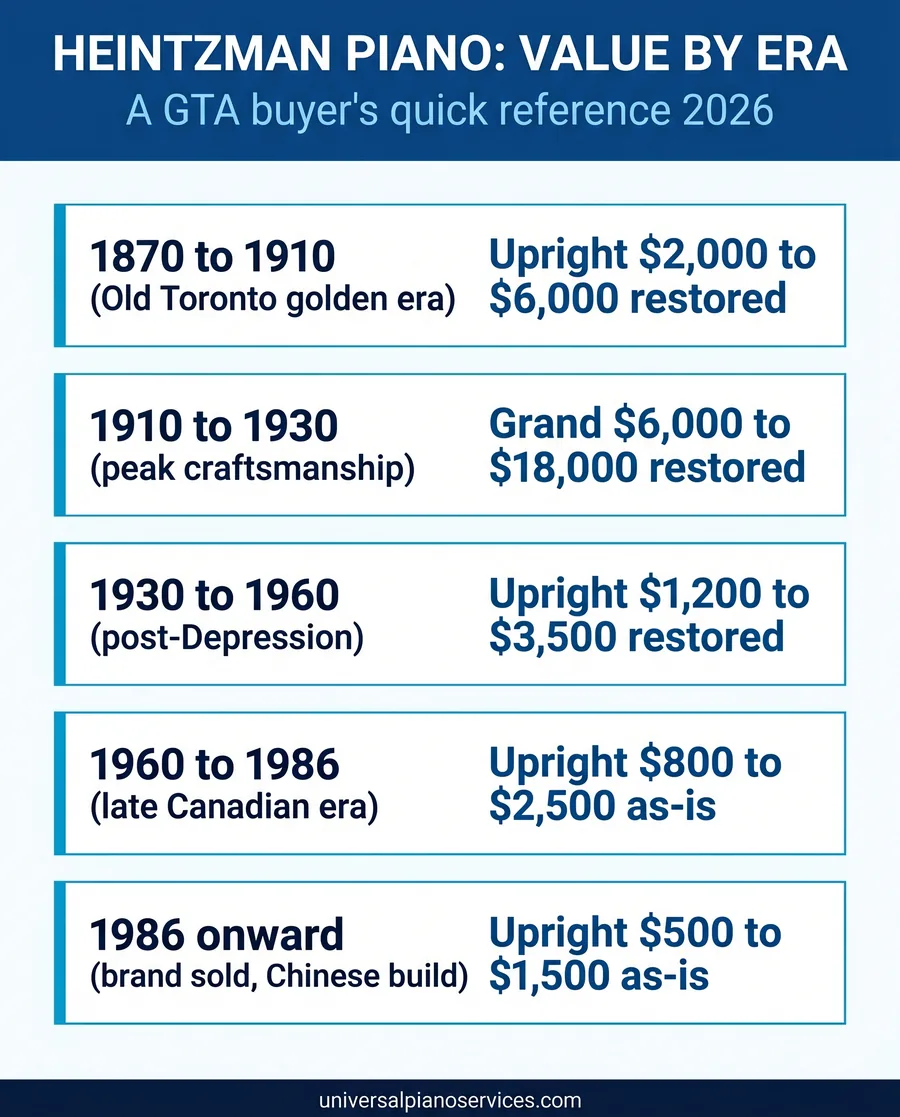
- 1870 to 1910 (Old Toronto). Hand-built, rosewood and walnut cabinets, often with elaborate carving. Uprights with action rebuilds run $2,000 to $6,000 in the GTA. Most have been restored or need it.
- 1910 to 1930 (peak). Considered by many technicians to be the best Heintzmans ever made. A fully rebuilt grand from this window sits in the $6,000 to $18,000 range depending on finish.
- 1930 to 1960 (post-Depression). Quality held up but scale dropped. Uprights from this era, restored, run $1,200 to $3,500.
- 1960 to 1986 (late Canadian). Still Toronto-built but design shortcuts creep in. Good players, not collector pieces. $800 to $2,500 as-is.
- 1986 onward (offshore Heintzman). Different factory, different country, same name on the fallboard. Treat as a mid-tier modern upright. $500 to $1,500 as-is in the GTA.
How to read the serial number and date the piano
The serial number is stamped in three places: on the cast iron plate (usually near the tuning pins), on the keybed under the keys, and sometimes on the back of the cabinet. Heintzman serial numbers cross-reference to build years in the published Pierce Piano Atlas and the Bluebook of Pianos. A piano dealer or a Registered Piano Technician can date the instrument for you in seconds.
The build year matters more than the nameplate style. A serial number that dates to 1915 is worth inspecting carefully. A serial number that dates to 1995, regardless of how grand the cabinet looks, is a modern offshore piano with a famous name.
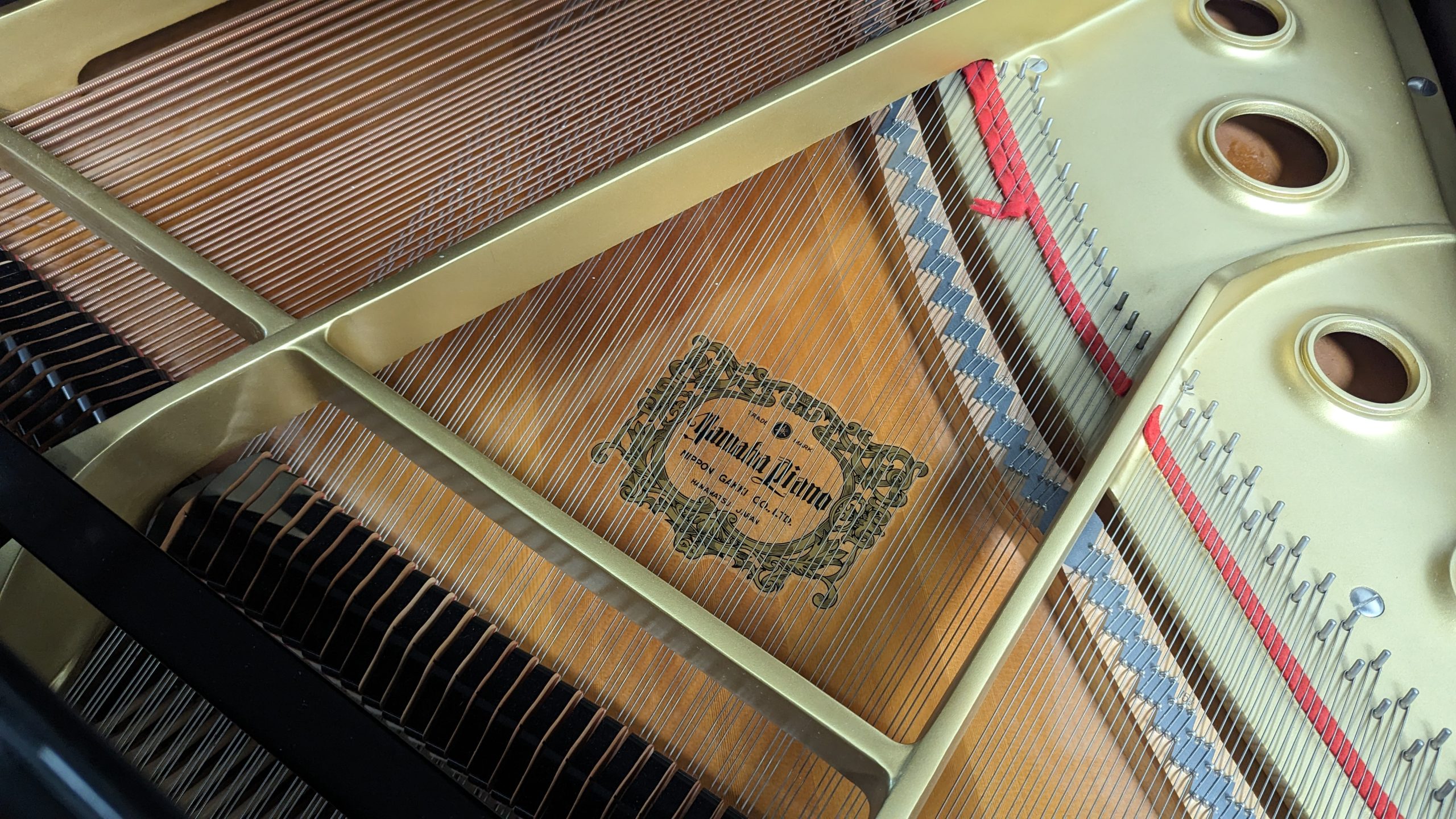
The action (the internal mechanism) is where a real Heintzman shows. Worn hammers and loose centre pins are cheap to fix. A cracked plate is not.
What to inspect on a used Heintzman before buying
For any pre-1986 Heintzman, the inspection order is the same. A real buyer looks at structure first, action second, and cosmetics last.
- The cast iron plate. Look for cracks. A cracked plate is a piano-killer and almost never worth repairing.
- The soundboard. Hairline with-grain cracks are fine. Cross-grain cracks or wide separations are a different story.
- The pin block. Put a tuning hammer on a tuning pin and check for slippage. Loose pins mean a rebuild is coming.
- The action. Hammers should strike evenly. Severely worn hammers and loose centre pins are fixable but add $800 to $2,500 depending on extent.
- Every key, played twice. Listen for silent keys, double strikes, sticking keys, and dead notes.
If you are not comfortable doing this yourself, book an inspection. The Piano Technicians Guild explains what a Registered Piano Technician does, and why the RPT credential is the one to ask for when you hire an inspector.
Realistic GTA prices for a used Heintzman in 2026
Prices move with the market and with the condition of the specific instrument, but here are honest ranges from the Toronto resale market in 2026 for common Heintzman models:
- Restored 1920s Heintzman 5 foot 1 baby grand: $9,000 to $18,000
- As-is 1920s Heintzman grand needing rebuild: $2,500 to $5,000
- Restored 1910 to 1930 Heintzman upright (48 to 52 inch): $3,500 to $6,500
- As-is 1950s to 1970s Heintzman upright: $1,200 to $2,800
- Offshore post-1986 Heintzman upright: $700 to $1,500
Grands retain value better than uprights across every era. Fully restored pianos retain value better than as-is. A proper restoration by a GTA shop runs $4,000 to $12,000 on an upright and $12,000 to $30,000 on a grand, so paying for an already-restored instrument is often cheaper than buying cheap and rebuilding.
When to walk away from a Heintzman
Some Heintzmans are not worth buying at any price. The short list: a cracked plate (rebuild cost exceeds instrument value), loose tuning pins that will no longer hold a turn (full pin block replacement on an old Heintzman runs $2,500 to $4,500), a badly crowned or split soundboard, or extensive termite or beetle damage to the case. Any one of these on an upright older than 1940 usually tips the math toward “pass”.
Walking away is not a failure. It is a sign you are buying well. A good Heintzman in the GTA turns up every few weeks. If the one in front of you has a structural flaw, the next one will not.
Get a professional assessment before you write a cheque
A one-hour inspection by a Registered Piano Technician runs $120 to $200 in the GTA. On a $5,000 purchase, that is a 3 percent insurance policy. On a $15,000 restored grand, it is closer to 1 percent. The inspection pays for itself the first time it keeps you out of a problem piano.
Universal Piano inspects and appraises vintage Heintzman pianos every week for buyers across the GTA. We can meet you at the seller’s home, go through the structure, action, and tone, and give you a flat written opinion: buy at this price, buy only with repairs factored in, or walk. If you are still in the shopping stage, the used pianos Toronto showroom carries a rotating selection of restored uprights and grands so you can hear what a proper Heintzman sounds like before you commit.
Heintzman piano buyer’s checklist – free PDF download
A printable checklist for the seller’s house: 10 items to verify before you put down a deposit.
Frequently asked questions
How do I tell a Canadian-built Heintzman from an offshore one?
The serial number dates the instrument. Any Heintzman with a build year before 1986 was made in Toronto. Anything 1990s or newer is the offshore Heintzman-branded line. Published piano atlases list every Heintzman serial range. A Registered Piano Technician can check this in seconds.
Are old Heintzmans worth restoring?
A 1910 to 1930 Heintzman grand is almost always worth restoring if the cast iron plate and soundboard are intact. Restoration on an upright from the same era can be economical if the cabinet is unusual or the buyer wants that specific instrument. Post-1960 Heintzmans are rarely worth full restoration. The math favours buying a newer used piano instead.
What is a fair price for a restored 1920s Heintzman grand in the GTA?
In 2026, restored 1920s Heintzman baby grands (5 foot 1 to 5 foot 9) sell in the $9,000 to $18,000 range depending on finish quality, whether the action and hammers were fully replaced or just reconditioned, and whether the case was refinished or left as original.
Is a Gerhard Heintzman the same as a Heintzman & Co?
No. Gerhard Heintzman was a separate company founded by Theodore Heintzman’s nephew in Toronto in the 1870s. Both companies made quality instruments and both used the Heintzman name. Gerhard Heintzman pianos are generally valued slightly below Heintzman & Co from the same era, but the inspection rules are identical.
Should I buy an as-is Heintzman and restore it myself?
Only if you already own piano-rebuilding skills and tools. A full upright restoration involves pin block replacement, action rebuild, string replacement, new hammers, and often refinishing. A professional GTA shop charges $4,000 to $12,000. A first-time rebuild without the right equipment usually costs more than that in parts, time, and mistakes.
Keep reading
Universal Piano has tuned, restored, moved, and appraised Heintzman pianos across Brampton, Vaughan, and every GTA city since 1982. If you have found a Heintzman you are thinking about buying, send us the serial number and five photos and we will tell you which era it is from, what condition flags we see, and what it should realistically cost. Visit the used pianos Toronto showroom to see restored examples in person, or use the contact form for a photo appraisal.