Piano Tips
Piano Humidity Control in GTA Winters: Stop Cracks & Pitch Drift
Apr
Last updated: June 9, 2026
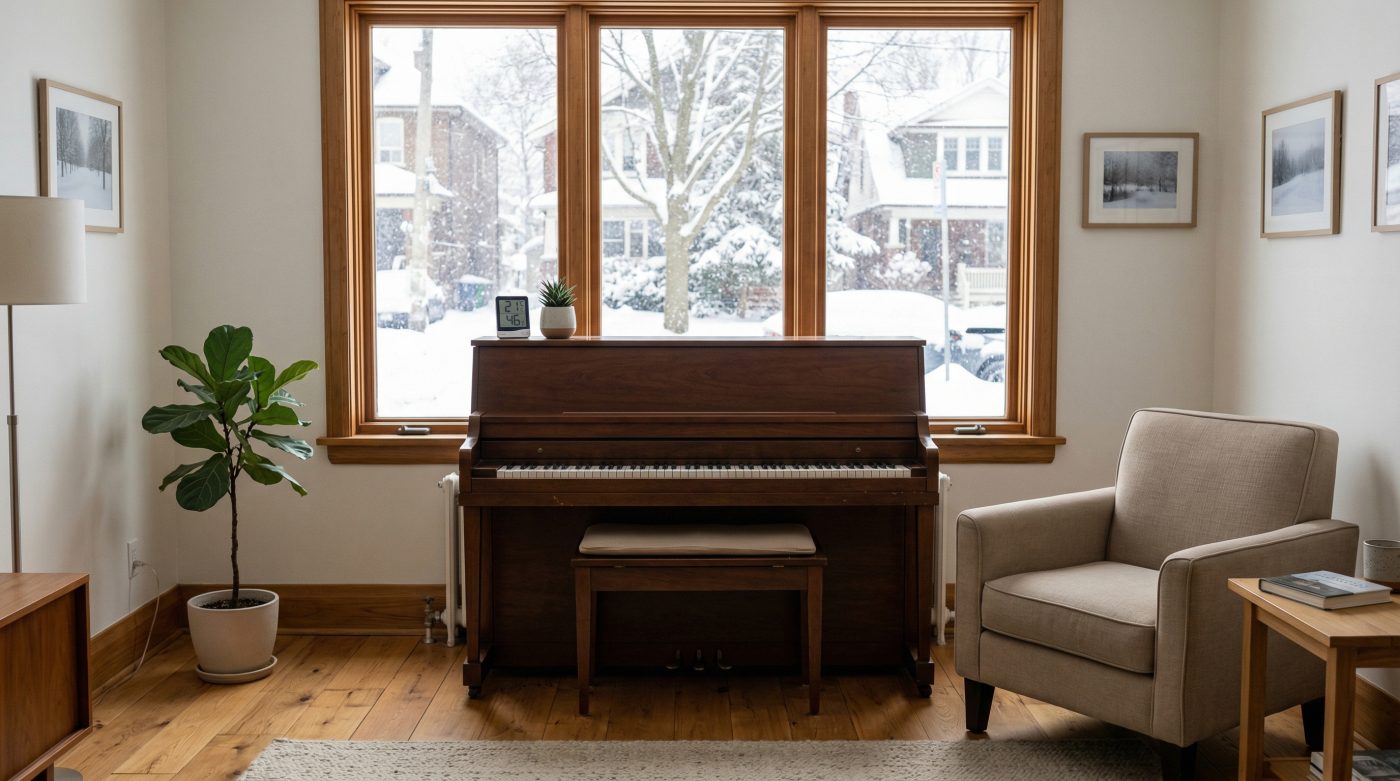
If you own a piano in the Greater Toronto Area, the single biggest threat to it is not your kids, your cat, or your last move. It is the severely dry air inside your house from November through March. A well-built upright or grand piano can last a hundred years in a stable climate, but two GTA winters in an under-humidified living room are enough to start cracking the soundboard, loosening the tuning pins, and destroying the instrument’s ability to hold pitch. Before you book another piano tuning service, the question worth answering is whether your piano is even capable of holding a tune in the room you have put it in.
What humidity actually does to a piano
A piano is roughly 80% wood by mass, and wood is hygroscopic, meaning it absorbs and releases moisture in response to the air around it. As humidity rises, wood swells. As humidity drops, wood shrinks. The soundboard, the bridges, and the pinblock are all made from specific species of wood (typically Sitka spruce and hard maple) that were dried and assembled at a specific moisture content. That moisture content corresponds to roughly 42% relative humidity (RH) at room temperature, which is the target the entire piano industry has converged on for the last seventy years.
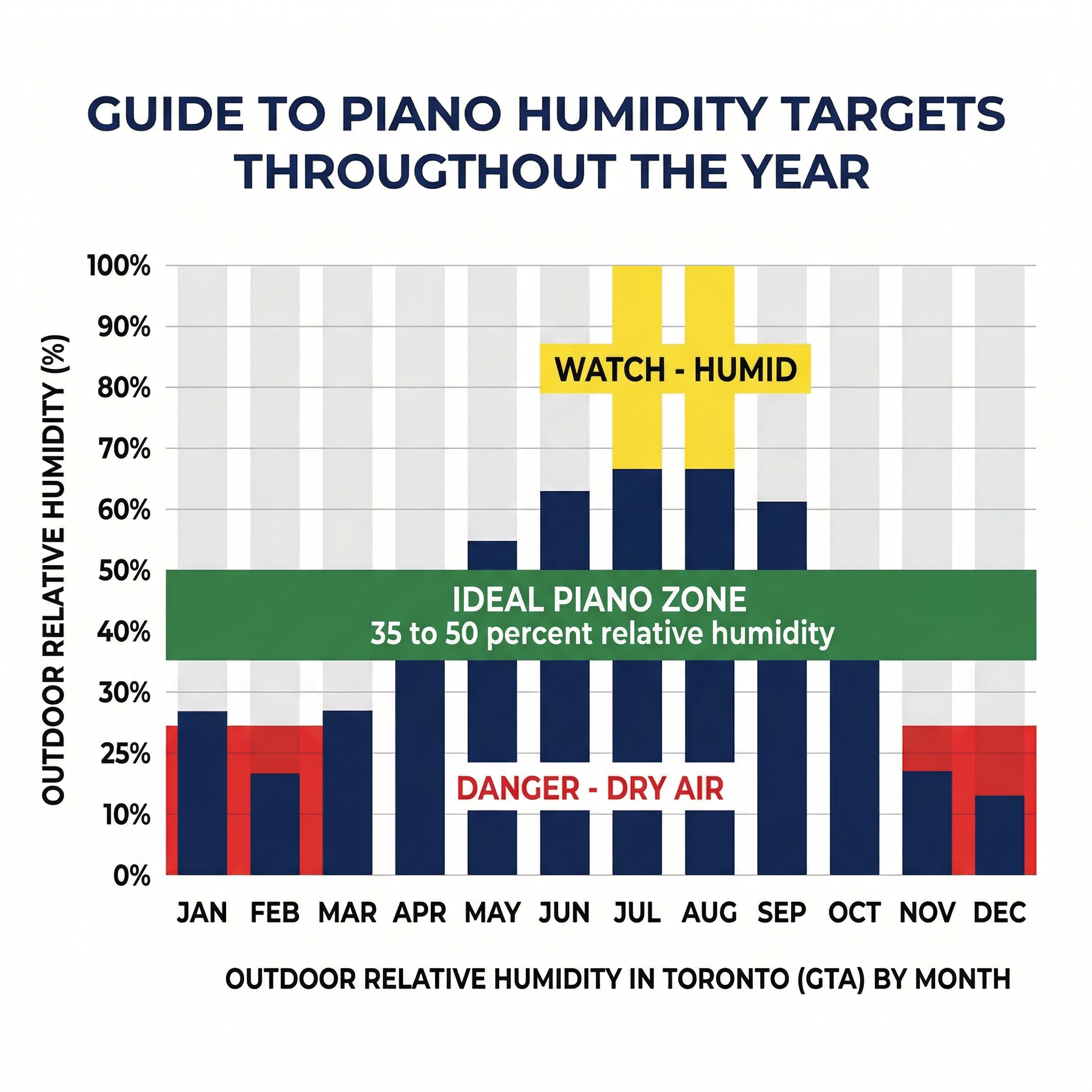
When the humidity in the room cycles between 65% in August and 18% in February, every structural wooden component is slowly being pulled in and out of shape. The damage is usually not catastrophic in any one cycle. It is cumulative. After three or four winters, you start to see the severe consequences.
The 3 main symptoms of dry-air structural damage
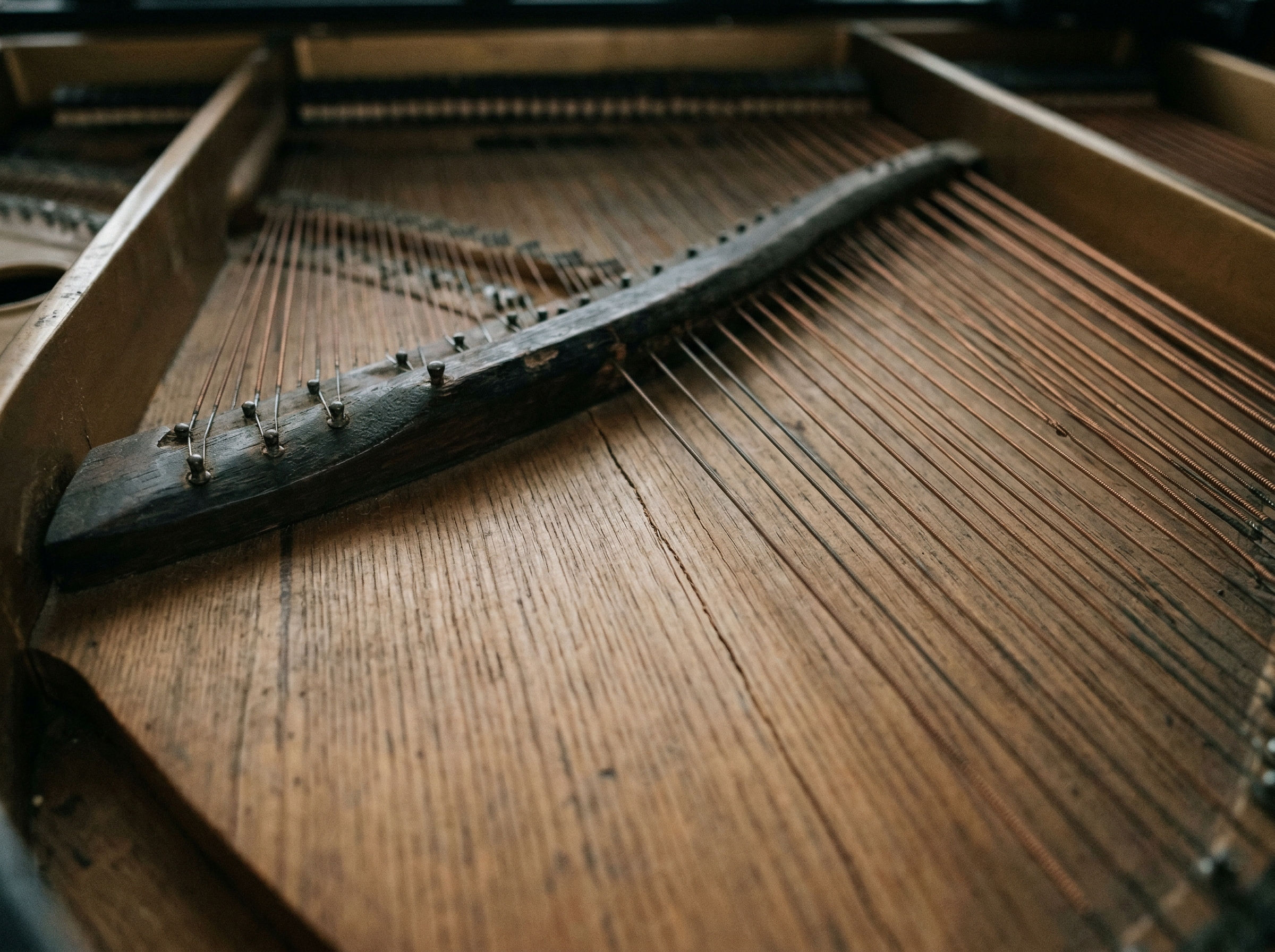
- Tuning instability (Pitch Drift). The soundboard shrinks across the grain in dry air, which lowers the downward pressure on the strings via the bridges. Pitch drops, often by 10 to 20 cents across the entire instrument over a single winter. The piano sounds flat and dull. Then in spring it rises again, but unevenly, leaving the unisons and octaves out of phase with each other.
- Soundboard cracks. When the soundboard shrinks faster than the ribs glued to its underside can let it, it splits along the grain. Small hairline cracks are cosmetic and common. Long open cracks that buzz when you play are a major structural problem and require a technician to shim or, in serious cases, replace the entire soundboard.
- Loose tuning pins. The pinblock is a laminated hardwood plank that grips the steel tuning pins by friction alone. As it dries and shrinks, that grip loosens. A piano with loose pins will not hold a tune for more than a few weeks regardless of how skilled the technician is.
What 42% RH actually looks like in a Toronto house
Most GTA homes run dramatically dry in winter. According to Environment Canada, outdoor relative humidity in Toronto in January averages around 70%, but the absolute moisture content of that cold air is very low. When you heat that air to 21°C indoors, the relative humidity drops to somewhere between 15 and 25 percent. Add a forced-air gas furnace blowing hot dry air through the supply ducts, and the room with the piano often sits at 18% RH for weeks at a time. That is drier than the Sahara Desert in summer.
Summer runs the opposite way. A humid Toronto July with no air conditioning will push your living room to 70 or 75 percent RH. The annual swing in an unmanaged room is routinely 15% to 75%. The annual swing the piano was built to tolerate is closer to 35% to 50%.
Three real fixes that work in the GTA
Fix 1: Whole-house humidifier on the furnace
If you have a forced-air gas furnace (most GTA homes do), the most reliable winter fix is a flow-through humidifier mounted on the supply or return plenum. Aprilaire 600 and Honeywell HE300 are the workhorses. Installed cost in the GTA is typically $700 to $1,200. A whole-house humidifier brings the entire main floor to 35 to 40 percent RH on the coldest nights, which is enough to protect the soundboard without fogging the windows.
Fix 2: A large freestanding humidifier in the room
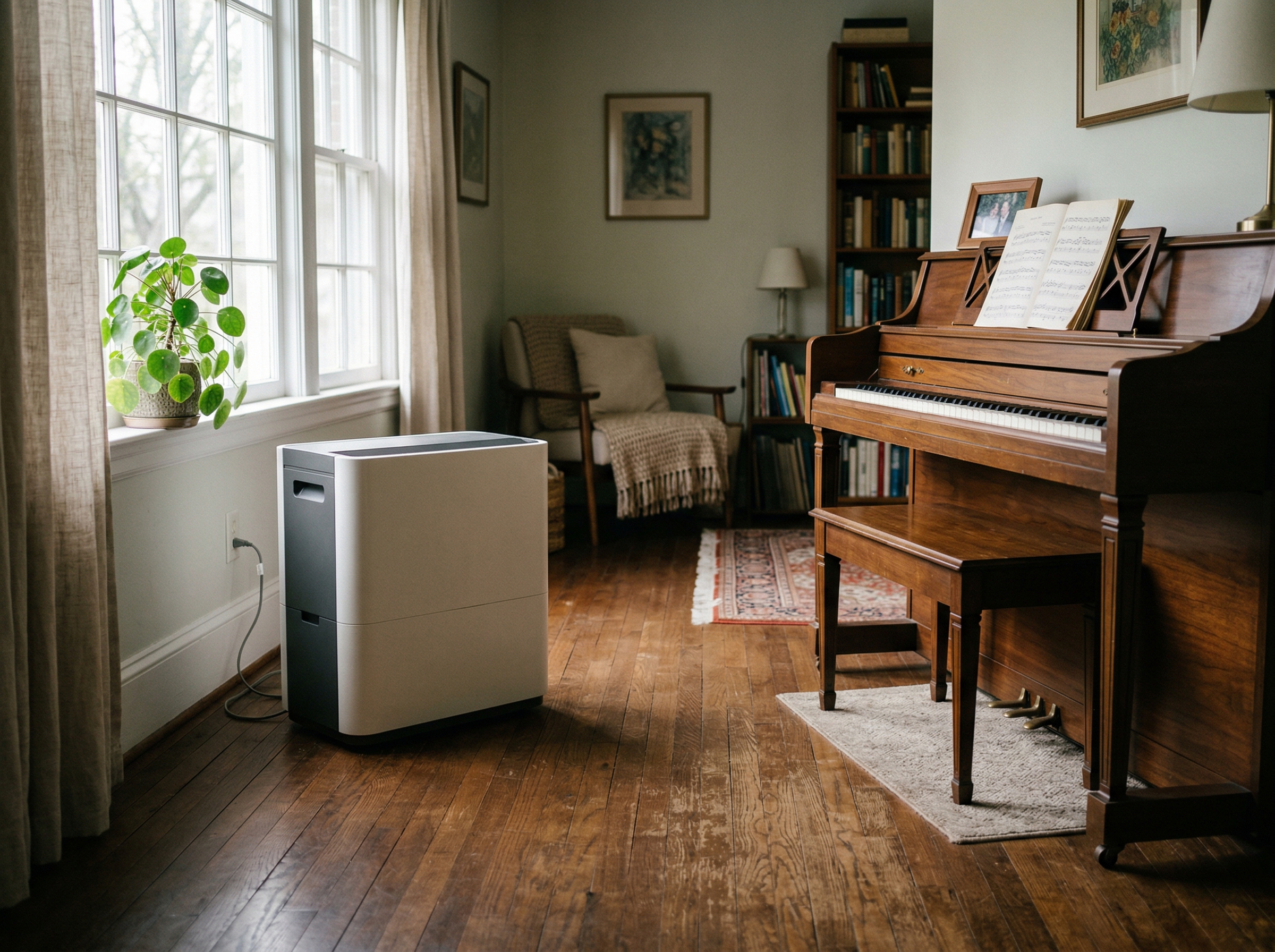
If you cannot install a furnace humidifier, a console humidifier in the same room as the piano is your next best option. You want at least a 4 to 6 gallon per day output. Place it across the room from the piano, never within 1 metre of the case. Run it on a humidistat set to 42%. Expect to spend about $200 to $350 on the unit and around $30 a month on filters and electricity.
Fix 3: A piano-mounted Dampp-Chaser system
For grand pianos, valuable instruments, or condo installations, the gold standard is an under-piano humidity control system. The Dampp-Chaser Piano Life Saver is a closed-loop system that mounts inside the case and combines a humidifier, a dehumidifier, and a humidistat that switches between them automatically. It keeps the soundboard at 42% RH regardless of what the room is doing. Installed cost in the GTA: $700 to $1,100 for an upright, $900 to $1,400 for a grand.
How to measure what you actually have
Before you spend any money on a fix, buy a $20 digital hygrometer and put it on top of the piano for two weeks in January and again for two weeks in July. Log the reading once a day. If you see the room cycling outside of 35% to 50% during either window, the structural integrity of your piano is at risk.
What humidity will not fix
Stable humidity is necessary but not sufficient. Even a perfectly humidified piano needs annual piano tuning service. If your piano is 40 years old and has never been serviced, humidity control alone will not bring it back. You may need structural piano repair, bridge re-capping, or in extreme cases full piano restoration. But do humidity first. Tuning a piano in a 18% RH room is throwing money away.
Frequently asked questions
What humidity should I keep my piano at in the winter?
Aim for 42% relative humidity year round, with no swing greater than about 10 percentage points either direction. In a Toronto winter that means humidifying actively.
Will a small ultrasonic humidifier next to the piano work?
Not really. A 1-gallon ultrasonic unit barely moves the needle in a typical GTA living room. It also throws fine mineral dust onto the piano case and finish if you use tap water. Plan to upgrade to a console or whole-house unit.
Can dry air damage a digital piano too?
Far less. Digital pianos have wood cabinets but no soundboard or pinblock to crack. Humidity extremes can affect the cabinet over many years, but the structural urgency is much lower than with an acoustic instrument.
How much does it cost to fix a cracked soundboard?
Hairline cracks that do not buzz are usually left alone. A single buzzing crack shimmed by a technician runs $400 to $900 in the GTA. Full soundboard replacement on a grand piano is $6,000 to $12,000 plus restringing, which is a $15,000 to $20,000 total job.
Is the Dampp-Chaser system safe?
Yes. The system is endorsed by every major piano manufacturer (Steinway, Yamaha, Kawai, Bösendorfer) and uses a Pad Treatment additive that prevents mould growth in the water reservoir.
Does my home insurance cover humidity damage to a piano?
Almost never. Standard home contents policies exclude damage from gradual deterioration, including dry-air cracking and warping.
Get a humidity check with your next tuning
Universal Piano Services has been tuning, repairing, and restoring pianos across the GTA for over 40 years. We bring a calibrated hygrometer to every appointment and can assess the room before we touch the instrument. If your piano has been struggling through GTA winters, request a quote and we will walk you through which humidity fix makes sense for your situation.
Related: piano care and piano restoration.