Piano Tips
The Ultimate Digital Pianos vs Acoustic Buying Guide for Modern Homes
Feb
Last updated: April 21, 2026
The Age-Old Musical Conundrum for Your Living Room
You have finally decided to bring music into your home. You clear a spot in the living room, picture yourself or your child mastering Chopin or playing along to your favorite pop ballads, and immediately hit a wall. Do you buy a traditional wooden instrument, or do you plug into the modern era?
As a seasoned piano professional, I have this exact conversation with families, aspiring musicians, and seasoned giggers almost every single day. The choice is not just about aesthetics. It fundamentally impacts how you play, how you learn, and how you live with the instrument. Let us cut through the marketing noise and look at the mechanical, financial, and practical realities of your options.
When comparing Digital pianos vs acoustic side by side, the core difference lies in sound production and maintenance. Acoustic pianos generate sound organically through wooden hammers striking steel strings, offering unmatched tonal richness and dynamic range but requiring regular tuning and climate control. Digital instruments use high-definition audio samples and sensors to replicate that sound, offering volume control, zero tuning costs, and portability. Ultimately, your choice depends on your budget, living situation, and whether you prioritize authentic acoustic resonance or modern convenience.
The Mechanics of Sound – Wood and Wire or Silicon and Samples?
To understand what you are buying, you have to understand how these machines actually breathe.
The Acoustic Ecosystem
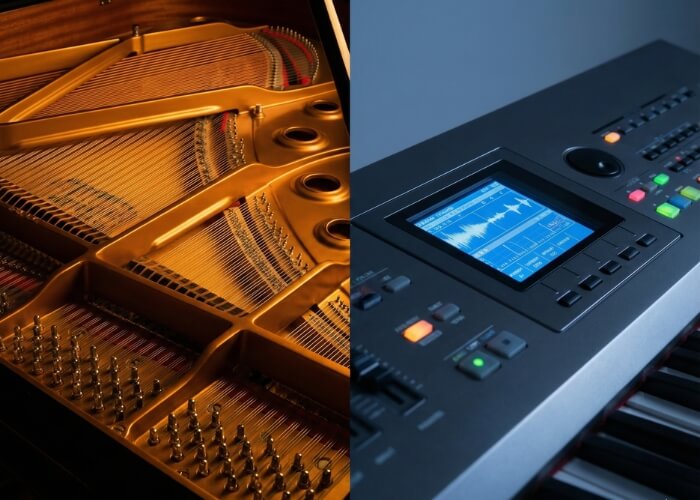
An acoustic piano is a living, breathing percussion instrument. When you press a key, you are triggering a massive chain reaction of thousands of moving parts. To truly understand how a traditional piano creates its nuanced sound, you have to look at the complex piano action, a marvel of engineering involving wippens, jacks, and repetition levers that ultimately throw a felt-covered hammer against high-tension steel strings. An average acoustic piano holds over 200 strings with a combined tension of roughly 18 tons.
The vibration of those strings transfers to a large wooden soundboard, which amplifies the sound naturally, filling the room. This organic creation of sound creates overtones and resonances that are entirely unique to that specific instrument on that specific day.
The Digital Brain
A digital piano, conversely, is a highly sophisticated computer masquerading as a musical instrument. There are no strings and no hammers actually striking anything to produce acoustic sound. Instead, when you press a key, a sensor measures the velocity of your strike and triggers a high-definition audio recording of a high-end concert grand piano.
Modern digital instruments boast features like 256-note polyphony. This means the computer processor can play 256 individual notes simultaneously before it begins dropping the oldest sounds. This is a crucial specification for playing advanced classical pieces with heavy sustain pedal use.
If you are deep-diving into the Digital pianos vs acoustic debate, understanding this sound origin is your baseline. One makes the sound, and the other reproduces it.

Touch Response and The Physical Connection
Let us talk about the physical connection between you and the keys. Ask any classical teacher, and they will likely harp on one specific word – action.
- The Authentic Resistance – Acoustic keys have a natural weight. You are physically lifting a mechanism, which requires finger strength. As you press down, you feel a slight mechanical bump right before the bottom of the keystroke known as escapement. This tactile feedback allows advanced players to play with incredible dynamic control, whispering a soft note or hammering out a loud chord.
- The Simulation – Digital models work incredibly hard to mimic this physical sensation using graded hammer action. This means the keys in the bass register feel heavier than the keys in the treble register, just like the real thing. While premium digital models get astonishingly close to the real feel, purists will argue that sensors can never fully replicate the infinitely variable physical feedback of real wood and felt.
Maintenance Realities – What Nobody Tells You About the Long Game
When weighing the long-term costs of Digital pianos vs acoustic ownership, maintenance is where the financial scales tip heavily in opposite directions.
The Care and Keeping of Wood
Because traditional pianos are made of organic materials like wood, felt, leather, and metal, they are highly susceptible to changes in humidity and temperature. The wood expands in humid Canadian summers and contracts in dry winters. As a result, the string tension fluctuates, and the instrument goes out of tune.
You need to tune an acoustic at least once, ideally twice, a year. That is why scheduling regular professional maintenance, such as booking a specialized tuning session for your instrument, is strictly non-negotiable if you want to protect your investment and your ear.
The Plug-and-Play Reality
Digital options require zero tuning. They are entirely immune to the humidity changes in your living room. Your primary maintenance involves wiping the dust off the keys. However, their lifespan is distinctly shorter. Electronic components degrade, and digital technology becomes obsolete. While a well-maintained acoustic can easily last 50 to 80 years, a digital keyboard’s functional lifespan is closer to 10 to 15 years before the sensors fail or the mainboard gives out.
Space, Volume, and Your Actual Living Situation
We have to anchor this decision in reality. Where do you live, and who are your neighbors?
For many of my clients living in condos, the comparison ends right here at the volume knob.
- Acoustic realities – Even an upright piano is incredibly loud. The sound travels through floors and walls. While you can install a dampener rail to mute the sound slightly, you cannot turn an acoustic down. Furthermore, they are heavy. A standard upright weighs between 400 and 500 pounds, requiring professional movers anytime you change addresses.
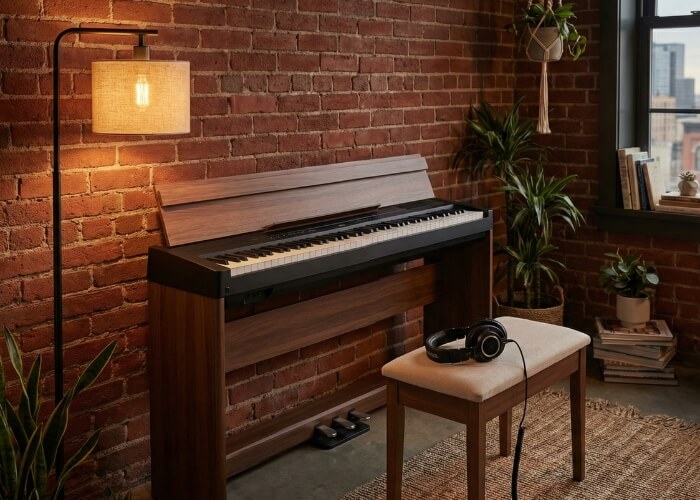
- Digital conveniences – Digitals offer ultimate volume control. You can turn the volume down to a whisper, or better yet, plug in a pair of headphones. You can practice complex scales at midnight while your family sleeps peacefully. Additionally, many digital console models weigh less than 100 pounds, making them incredibly easy to move.
The Final Chord – Making Your Decision
At the end of the day, navigating the world of Digital pianos vs acoustic models is about finding the right partn er for your musical goals.
If you are a serious classical student, demand the absolute best in expressive dynamic range, have the space, and are willing to commit to the annual upkeep, the rich resonance of a traditional wooden instrument simply cannot be beaten. It is a heritage piece that commands a room.
However, if you are a beginner looking for an affordable entry point, an apartment dweller worried about noise complaints, or an enthusiast who loves the idea of recording directly to a laptop, a high-quality digital model is undeniably the smarter, more practical choice.
You do not have to make this choice blindly. If you are ready to test the waters yourself, I highly recommend exploring our comprehensive piano buying guide to dig deeper into the specific brands and models that fit your unique lifestyle. Get your hands on the keys, feel the difference, and let your ears make the final call. Would you like me to help you compare specific models you have in mind?