Piano Tips
Yamaha U1 and Kawai K-300 Upright Piano Full Comparison
Feb
Last updated: April 21, 2026
The Reality of the “Big Two” Showdown
You’re standing in a piano showroom. To your left sits a Yamaha. To your right, a Kawai. You’ve just stumbled into the acoustic piano equivalent of the heavyweight championship.
If you are shopping for a professional-grade upright piano, you are inevitably going to compare the two most sold pianos on the planet: the Yamaha U1 and the Kawai K-300 (the modern successor to the legendary Kawai K-3).
For decades, these two 48-inch Japanese titans have dominated music schools, recording studios, and living rooms. They sit at the exact intersection of premium craftsmanship and relative affordability. But here is the hard truth that most salespeople won’t tell you: despite looking nearly identical from the outside, they are entirely different beasts under the hood. They feel different. They sound different. They even react to your living room’s humidity differently.
At Universal Piano Services, we’ve spent years restoring, tuning, and playing both of these incredible instruments. Let’s strip away the marketing jargon and look at exactly what you are paying for when you choose between the world’s two most popular pianos.
The Yamaha U1: The Undisputed Studio Standard
There is a reason the Yamaha U1 is the most requested piano by piano teachers worldwide. It is the definition of a workhorse. Built with rigid precision, the U1 is famous for a sound that “cuts through the mix.”
The Tonal Profile: Bright, Crisp, and Unapologetic
Strike a chord on a Yamaha U1, and you get instant gratification. The sound is highly articulate.
- The Attack: Sharp and immediate. You hear the exact moment the hammer strikes the string.
- The Repertoire: Because of its crystalline highs, the U1 sounds spectacular when playing pop, jazz, or fast classical pieces (think Mozart or Scarlatti) where note separation is crucial.
- The Drawback: In a room with hardwood floors and lots of windows, a U1 can sometimes sound too bright, border-lining on piercing if not voiced properly by a technician.

The Action: Traditional Wooden Precision
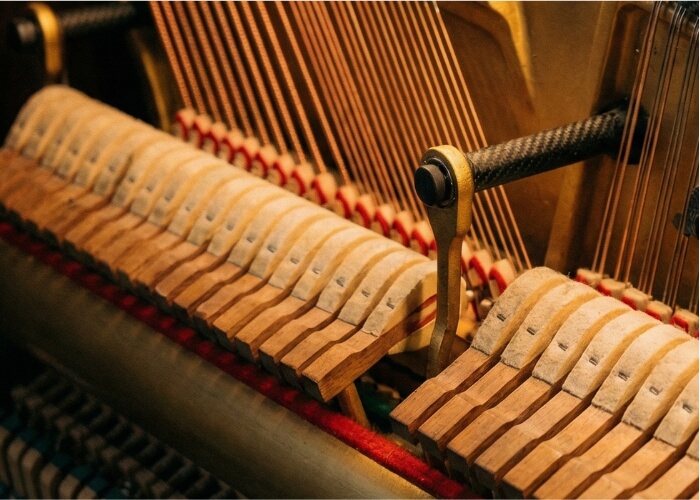
Yamaha has stuck to a tried-and-true formula for its internal mechanics. The action (the complex system of levers that connects the key to the hammer) is made entirely of high-quality, seasoned wood.
Wood is traditional. It is what master builders have used for three centuries. When regulated properly, a U1’s wooden action feels incredibly responsive and slightly “lighter” under the fingers, allowing for lightning-fast trills and repetitions.
The Kawai K-300: The Warm, High-Tech Innovator
If Yamaha is the crisp, traditional studio monitor, Kawai is the warm, velvety vinyl record. The Kawai K-300 was designed specifically to fix the common complaints people had about brighter pianos, and they used radical technology to do it.
The Tonal Profile: Dark, Rich, and Orchestral
Kawai engineers intentionally design their pianos to produce a “rounder” tone.
- The Bass: The K-300 features slightly longer bass strings than the U1. This gives the lower register a booming, resonant depth that you typically only expect from a baby grand.
- The Repertoire: This piano begs you to play Chopin, Debussy, and sweeping cinematic film scores. The notes blend together beautifully, creating a wash of rich overtones.
- The Drawback: For incredibly fast, rhythmic playing, the darker tone can occasionally sound a bit “muddy” compared to the laser-focus of the Yamaha.
The Action: The ABS-Carbon Controversy
Here is where Kawai completely rewrote the rulebook. Instead of wood, Kawai uses a proprietary composite material called ABS-Carbon (carbon fiber) in their Millennium III action.
Piano purists initially scoffed at the idea of plastic and carbon fiber in a piano. But the science is undeniable. If you look at the fundamental mechanics of piano action, wood is porous. It swells in the humid summer and shrinks in the dry winter. Carbon fiber does not.
Because of this, the Kawai K-300’s action is practically immune to weather changes. It remains incredibly consistent year-round. It feels slightly “heavier” or meatier than the Yamaha, giving advanced players a profound sense of control over their dynamics.
Head-to-Head: Where Your Money Actually Goes
So, you have a budget, and you’re staring at both models. Which one actually deserves a spot in your home?
1. Maintenance and Longevity
Both of these pianos are built to last 50 to 60 years if maintained properly. However, living in areas with massive seasonal shifts—like we have here in Toronto—changes the equation.
Because of its wooden action, the Yamaha U1 may require slightly more frequent micro-adjustments to keep the touch absolutely perfect during seasonal transitions. The Kawai’s composite parts will shrug off humidity changes better. Regardless of which you choose, investing in regular piano tuning at least once or twice a year is non-negotiable if you want to protect your investment.
2. The Resale Value Reality
Let’s talk money. Buying a new or used U1 or K-300 is basically like parking your money in a high-yield savings account compared to buying an unknown brand.
Because the Yamaha U1 has been the global standard for so long, it has unparalleled brand recognition. If you decide to sell your U1 in ten years, you will find a buyer in days. It holds its value aggressively.
The Kawai K-300 holds its value exceptionally well too, but Yamaha’s sheer brand dominance gives it a slight edge in the ultra-fast resale market. If you are looking to save significantly on your initial purchase without sacrificing quality, browsing high-quality used pianos in Toronto is often the smartest financial move, as these specific models depreciate very slowly after their first few years.
3. The “Finger Test”
Specs and soundboards don’t play the piano; your fingers do.
- If you have a heavy hand and struggle to play quietly, the heavier touch and mellow tone of the Kawai K-300 will help you sound much more expressive.
- If you have a lighter touch and want your melodies to sing out effortlessly over your left-hand chords, the Yamaha U1 will make you feel like a virtuoso.
The Piano You Should Actually Bring Home
We could spend hours dissecting soundboard spruce grains and hammer felt densities, but your decision ultimately comes down to your ear and your environment.
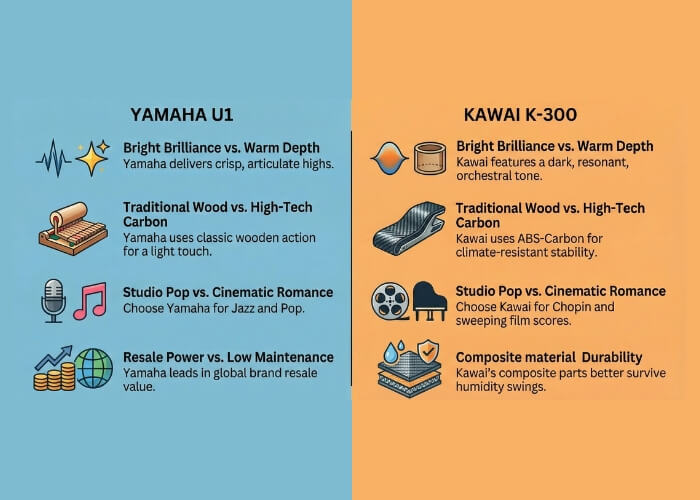
Choose the Yamaha U1 if you love a bright, energetic sound, if you play a lot of pop or jazz, and if you want the absolute gold standard of brand-name resale value.
Choose the Kawai K-300 if you prefer a warm, romantic, cinematic tone, if you want the low-maintenance reliability of carbon-fiber action, and if you love a deeper, richer bass response.
Don’t buy a piano based purely on a YouTube video’s audio compression. Get off the internet, find a reputable piano dealer, and play a C-major chord on both. One will sound like a piano. The other will sound like your piano.