Piano Guides
Mercedes Piano Evaluation: Build Quality and Brand History

Oct
Someone brings in a Mercedes piano and asks the obvious question first: is this worth anything, and is it related to the car company? It is not related to Mercedes-Benz in any way. Reading a Mercedes piano well means setting the name aside and reading the instrument in front of you, the same way you would with any piano that shows up for guidance on purchasing a piano without a famous nameplate attached.
That is the real subject here: what the record actually says about the Mercedes piano name, and how to evaluate the build quality of the Mercedes piano in front of you, regardless of who stencilled the fallboard.
What is a Mercedes piano, and why is its history so thin?
Mercedes is a genuine piano nameplate. It shows up in the registries piano people use to track manufacturer names, and on our own list of brands we have handled. What it does not have is a clean paper trail: no widely published founding date, no well documented factory address, and no settled account of who built the instruments or where.
That is a real gap, and we would rather tell you it is a gap than fill it with something that sounds plausible. A Mercedes piano is one of many instruments where the paper trail is thin, which is exactly why the piano in front of you matters more than the name on it. A confident date here is usually a guess dressed up as fact.
Did you know
A large share of pianos built in the early to mid twentieth century carried a name chosen by the retailer selling them rather than the workshop that built them, a practice piano people call stencilling. It was a normal way to do business, not a sign of a shortcut on the build, and it is one reason thousands of names show up in the historical registries with little more than the name attached.

Why the name tells you less than the build
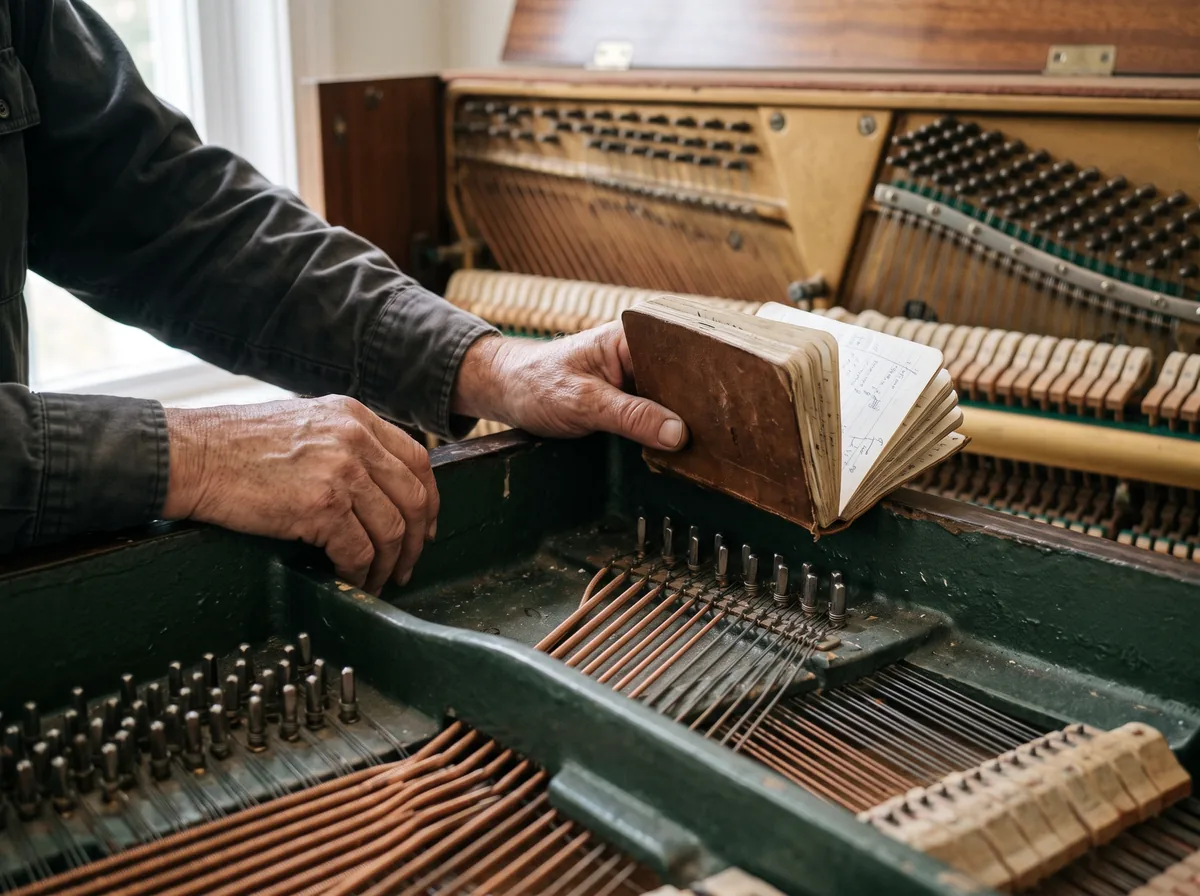
A famous name on the fallboard is a shortcut. It lets a buyer assume quality without checking, and most of the time that shortcut is earned. A Mercedes piano removes the shortcut, but not the piano’s actual quality, which was set the day it was built and has nothing to do with how well its history was recorded.
In practice, a Mercedes piano and a famous-name piano can sit side by side and the Mercedes piano can be the better instrument, once you open the lid and check. The rest of this guide is that checking process, from the plate down to the hammers.
How to evaluate any piano’s build quality
None of the steps below require you to know who built a Mercedes piano. They only require you to look closely at the parts that determine how the piano sounds and how long it stays playable between tunings.
Find and read the serial number
Start here, on a Mercedes piano or any other. On an upright, the serial number is usually stamped on the iron plate visible when you lift the top lid, near the tuning pins or along the plate’s edge. On a grand, look on the plate near the tuning pins or the far side of the rim under the lid. Write the number down exactly as it appears, including any letters.
For manufacturers with a long public record, a serial number can be cross-referenced against published ranges to estimate a build year. For a Mercedes piano, the number may not resolve to a documented range at all, worth knowing before anyone quotes an age with confidence. The Pierce Piano Atlas is the reference most technicians reach for first.
What the plate and stringing scale tell you
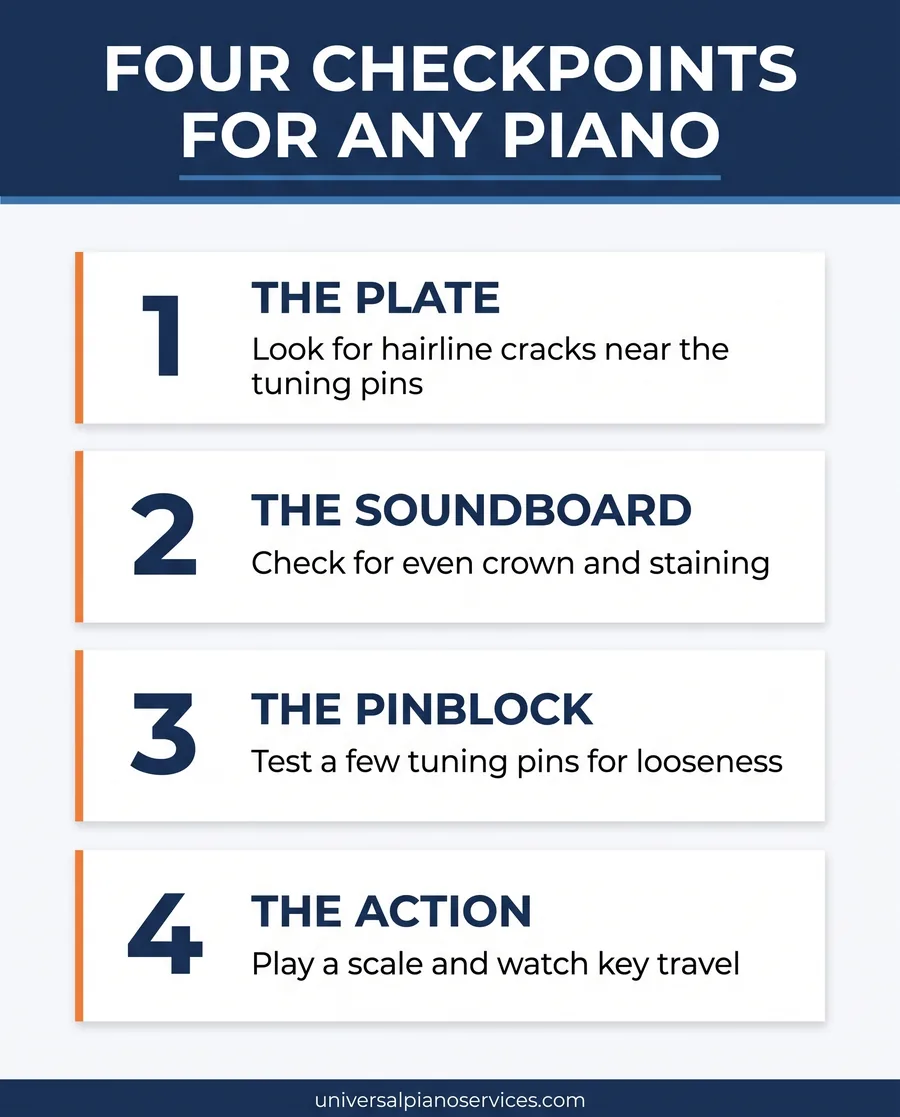
The cast iron plate is a Mercedes piano’s skeleton, holding roughly eighteen tons of string tension so the wooden structure underneath does not have to. Look for hairline cracks near the tuning pins or mounting bolts, and for any repair welds. The scale design, meaning the speaking length, diameter, material and tension chosen for each string, has more influence on tone than almost anything else, and it is set in the design regardless of the name on the fallboard. As Yamaha’s piano guide shows, strings get shorter and thinner from the bass to the treble, bass strings are wound with copper while tenor and treble strings are plain wire, and the tension is balanced across the whole set. The bass strings crossing over the tenor strings is a separate feature, called cross-stringing or overstringing, which lets longer bass strings fit inside the case.
Soundboard condition and crown
The soundboard is the thin wooden panel that turns string vibration into sound. A healthy soundboard has a slight upward arch called crown, which keeps the strings pressing down with even force. On a Mercedes piano, look at the board from an angle in raking light. A board gone flat, or showing dark staining from old water exposure, tells you something no nameplate can override.
Checking for cracks and loose ribs
Small, stable soundboard cracks are common on older pianos and are not automatically disqualifying. What matters more is whether a crack has widened, runs across a rib, or produces a buzz on specific notes. On a Mercedes piano, a rib that has come loose from the board usually announces itself the same way, with a rattling tone in one part of the keyboard.
People often ask
Does a Mercedes piano need every crack repaired before it is playable? Not necessarily. Many stable, well aged cracks sit for decades without affecting tone. Sound decides the question more than appearance: if a crack or a loose rib is producing a buzz you can hear, have a technician look at it. If it is silent and unchanged, it is often just part of the piano’s history.
Pinblock tightness and tuning stability
The pinblock is the laminated wood block that grips every tuning pin. If it has dried out or cracked, pins turn loose instead of resisting the tuner’s wrench, and a Mercedes piano will not hold pitch even after a careful tuning. Do not manipulate tuning pins. Have a qualified piano technician test pin torque and tuning stability. Pins that spin freely in more than one area point toward a pinblock problem that a routine piano tuning will not fix on its own.
Action regulation and key travel
Play a slow chromatic scale on the Mercedes piano from the bottom of the keyboard to the top. Keys should travel an even, consistent distance, return promptly, and produce a reasonably even volume note to note. Sticking keys, or a section that feels heavier or lighter than the rest, usually points to an action that needs regulation rather than a design flaw.
Hammer wear and felt condition
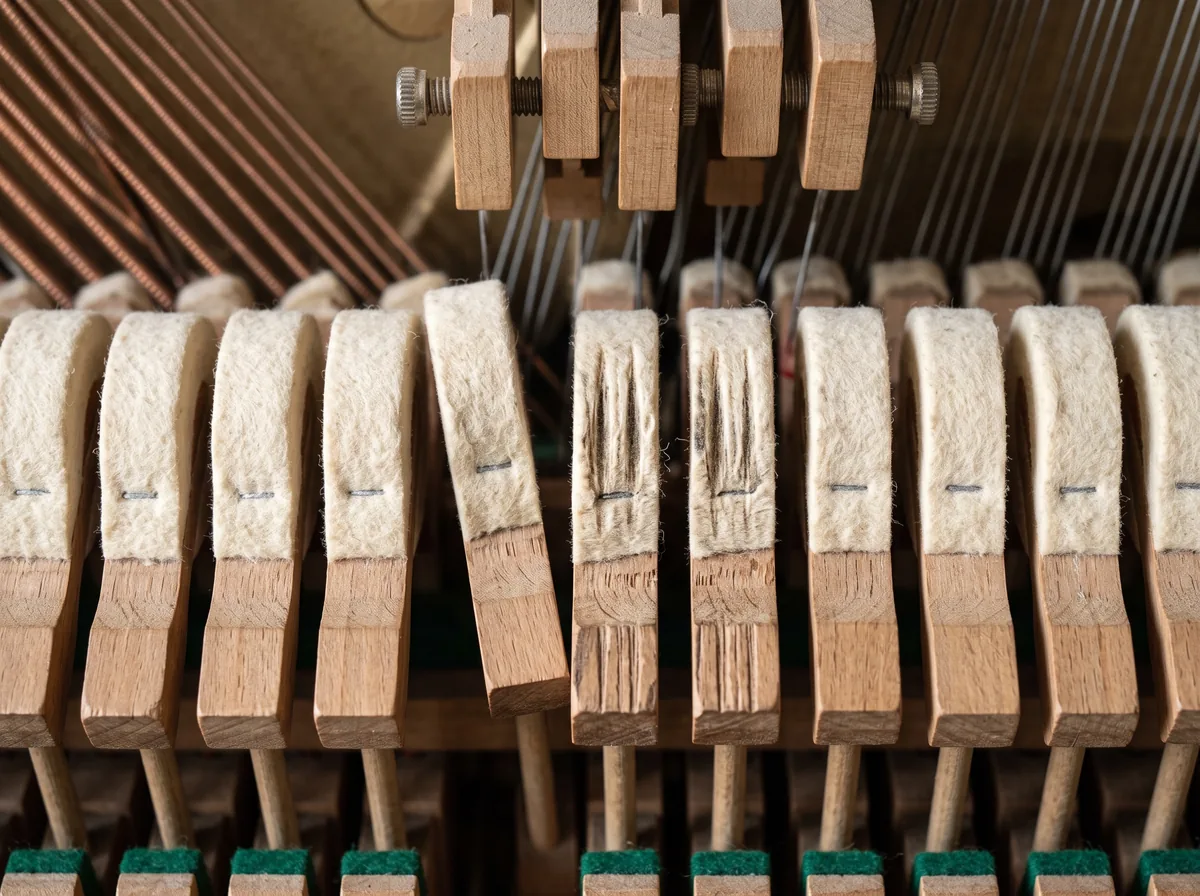
Look at the hammers, the felt-covered heads that strike the strings. Deep grooves worn into the felt where the strings cut in over years of playing will thin and harden a Mercedes piano’s tone. Run a finger lightly over a hammer’s surface, if you can reach it safely, and compare wear across the bass, middle and treble sections. Uneven wear in the middle octaves is common on any well used piano, name aside.
Cabinet condition versus musical condition
A glossy cabinet and a strong musical instrument are two separate questions on a Mercedes piano. A refinished case can sit over a tired soundboard, and a scuffed, unglamorous cabinet can hide a genuinely solid instrument underneath. Judge the finish on its own terms, as something cosmetic refinishing work can always address later, separate from the checks above.
Good to know
This guide explains what a piano’s build quality involves so you can look at a Mercedes piano, or any other, with more informed eyes. It is not an appraisal or a substitute for a hands on inspection. Condition, tone and value depend on the specific instrument, and any figures or repair outcomes should be confirmed by a qualified technician or appraiser before you rely on them. Universal Piano Services is not responsible for decisions made solely on this article.
When a professional appraisal earns its keep
Everything above will get you a genuinely informed first look at a Mercedes piano. It will not replace a trained ear and a trained set of hands, particularly on a name without a documented history to lean on. Tuning stability, hidden cracks, action wear and the true state of the soundboard are easy to misjudge from the outside, and that is exactly what a professional inspection is built to catch.
If you are close to a decision on a Mercedes piano, whether buying, selling or inheriting one, a professional piano appraisal turns an educated guess into a documented assessment.
Download the free quick guide
A printable walk-through for any piano viewing, covering every checkpoint from this guide in one place.
Frequently asked questions
Is a Mercedes piano connected to the Mercedes-Benz car company?
No. There is no ownership or manufacturing connection between the Mercedes piano nameplate and the German automaker. The two simply share a name, which happens often in the piano world since names were chosen freely by workshops, distributors and retailers over the past century. If you are researching a Mercedes piano, automotive history will not tell you anything about the instrument’s build or condition.
Where exactly do I find the serial number on my piano?
On an upright, lift the top lid and look at the cast iron plate, often near the tuning pins or along its visible edge. On a grand, check the plate near the tuning pins or the far side of the rim under the raised lid. Some pianos also stamp a number on the wooden frame beneath the keys. Write down every character exactly as it appears, since letters and spacing both matter when you place the number later.
Can I figure out a Mercedes piano’s age from the serial number alone?
Sometimes, and sometimes not. For manufacturers with a long, well documented public record, a serial number can often be matched against published ranges to estimate a build year fairly closely. For a Mercedes piano, that same number may not appear in any published range, which is common rather than unusual. In that situation, an experienced appraiser looking at construction details alongside the number will generally get you closer than the number alone.
Does a hollow or buzzing sound always mean a piano needs repair?
Not always, but it is worth investigating rather than ignoring. A buzz can come from something as simple as a loose screw on a nearby panel, or from something more involved like a loose rib or a worn hammer contact point. The sound alone will not tell you which one you have. Note where on the keyboard it happens and bring that detail to whoever inspects the instrument.
Is a piano with an unfamiliar name automatically lower quality?
No, and treating an unfamiliar name as an automatic downgrade is a common mistake. Build quality was set on the day the piano was built, not by how well its history was later documented. Plenty of thinly documented instruments were built with real care and hold up well today, and plenty of well known names have tired, heavily worn examples out there too. The build is always the more reliable signal.
A thin history is not a verdict on a piano, just a gap to work around by looking closer. Spend real time at the plate, the soundboard and the keys before you look at the finish, and lean on a professional when the decision is bigger than a quick look can settle.
Our team in the GTA handles Mercedes pianos and plenty of other thinly documented names every week. For a second set of trained eyes on one, book a GTA piano appraisal and we will walk through it with you in person.